


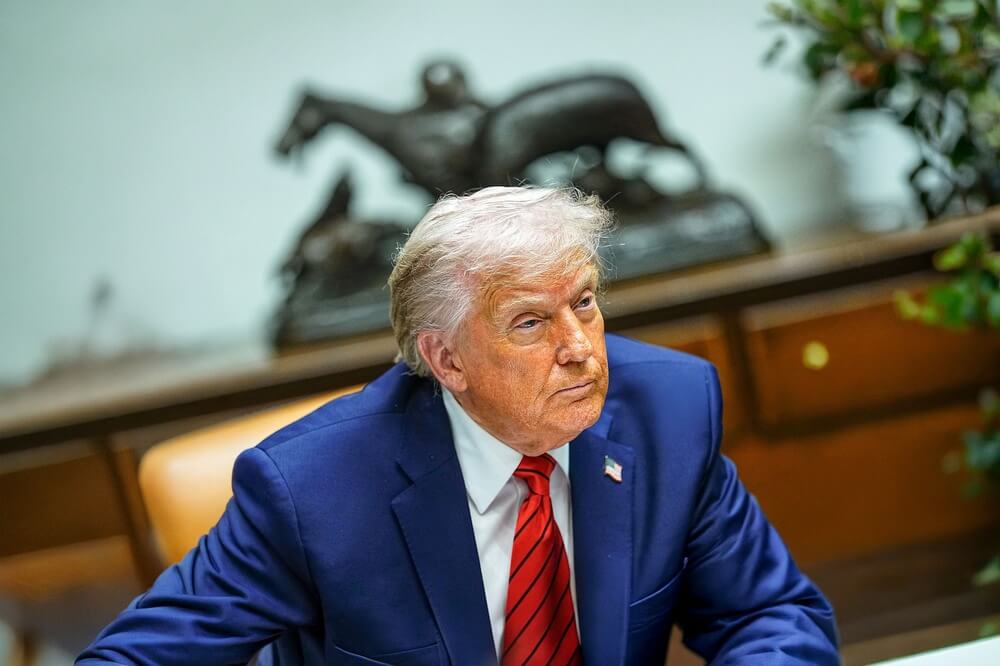
US President Donald Trump has signed an executive order that threatens new tariffs on countries that continue to trade with Iran. The order does not set a fixed rate but uses 25 percent as an example. It says the tariff could apply to goods imported into the United States from any nation that directly or indirectly buys goods or services from Iran.
Trump did not comment directly on the order but repeated that Iran must not obtain nuclear weapons. He spoke from Air Force One while senior US and Iranian officials held talks in Oman after weeks of escalating threats.
Trump had already threatened a 25 percent tariff on countries doing business with Iran earlier this year. On 12 January, he wrote that any country trading with Iran would immediately face tariffs on all business with the United States. Officials provided no details on how the tariffs would work in practice.
The White House said the order reaffirmed the ongoing national emergency related to Iran. It added that the president could modify the order if circumstances change. The statement accused Iran of pursuing nuclear capabilities, supporting terrorism, developing ballistic missiles, and destabilising the region.
Washington Adds Sanctions While Iran Holds Back Comment
The US State Department announced sanctions on 15 entities that traded Iranian crude oil, petroleum products, or petrochemical goods. Iran did not issue an immediate response. The country already faces extensive sanctions over its nuclear programme.
Iran insists its nuclear programme is peaceful and repeatedly denies seeking nuclear weapons.
Under the 2015 nuclear deal, Iran could not enrich uranium above 3.67 percent purity and could not enrich uranium at the Fordo plant for 15 years. Trump withdrew from the deal in 2018 and restored US sanctions, which severely weakened Iran’s economy.
Those sanctions targeted oil exports, shipping, and banks and included secondary sanctions on countries trading with Iran. Iran responded by violating several restrictions, especially those on uranium enrichment.
Last year, the United Nations reimposed economic and military sanctions after the UK, France, and Germany accused Iran of nuclear escalation and poor cooperation.
Iran Keeps Major Trading Partners Despite Pressure
More than 100 countries still trade with Iran despite sanctions. China remains Iran’s largest export partner. Beijing bought more than 14 billion dollars in Iranian goods in the year to October 2025. Iraq followed with imports worth 10.5 billion dollars.
The United Arab Emirates and Turkey also rank among Iran’s largest customers. Iranian exports to Turkey increased from 4.7 billion dollars in 2024 to 7.3 billion dollars last year.
Oman Talks Bring Cautious Optimism and Sharp Warnings
The talks in Oman mark the first meeting between US and Iranian officials since June, when the US bombed Iran’s three main nuclear facilities. Iranian Foreign Minister Abbas Araghchi led Iran’s delegation. Special envoy Steve Witkoff and Jared Kushner represented the United States.
Trump said the talks were very good and claimed Iran wanted a deal badly. He warned that consequences would be severe without an agreement and said another meeting would take place early next week.
Oman’s Foreign Minister Badr Albusaidi said the talks clarified both sides’ thinking and identified possible areas of progress. Araghchi described the talks as a good start and said a positive atmosphere prevailed. Delegations returned to their capitals for consultations.
Conflict Fears Rise as US Boosts Military Presence
Rising tensions between the United States and Iran have increased fears of conflict. Trump said Iran’s Supreme Leader Ayatollah Ali Khamenei should be very worried. He said he would strike Iran if it refused to reach a nuclear deal.
Iran continues to insist its nuclear programme is peaceful. The United States has strengthened its military presence in the region and described it as a massive armada. Trump linked the build-up to Iran’s violent crackdown on nationwide protests last month.
Human rights groups said thousands of people died in the crackdown. The full scale of the violence remains unclear because the government restricted internet access since 8 January.
