


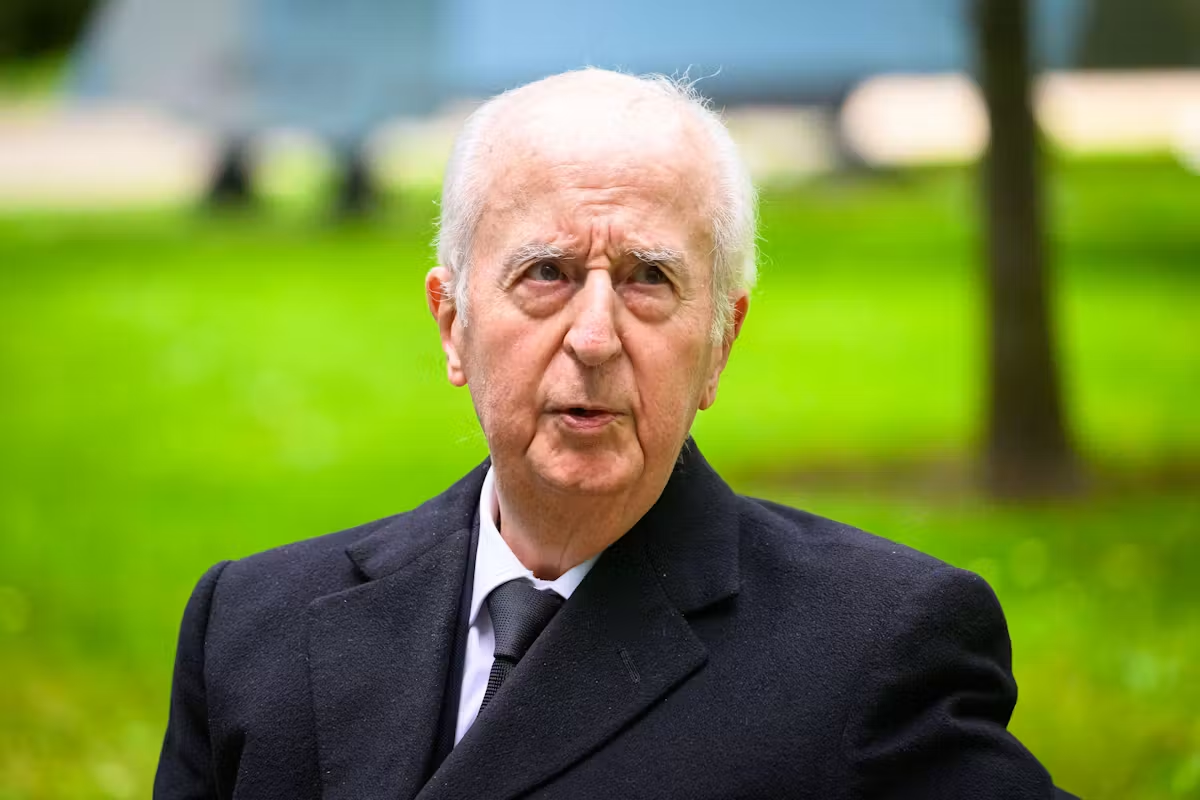
Former French Prime Minister Edouard Balladur has died in Paris at the age of 97, his family confirmed this week, closing a chapter on one of the most defining careers in modern French politics. The current prime minister announced the news, calling Balladur a man tied closely to fifty years of the country’s political history. No cause of death was given.
Balladur led the French government from 1993 to 1995, serving as the last prime minister under President Francois Mitterrand before running his own campaign for the presidency. He was born in 1929 in the coastal city of Izmir, in what was then the Ottoman Empire, into a family with deep ties to the local French community. His family left in the 1930s and settled in Marseille, where he grew up before beginning a long career in public service.
During his time as prime minister, Balladur became known for a sweeping wave of privatizations that reshaped major parts of the French economy. His government sold off some of the country’s most prominent state owned companies, including major banks and the national television broadcaster TF1. He also pushed through a significant overhaul of the country’s pension system in 1993, a politically sensitive move that still echoes in debates over retirement policy today.
His time in office ended with a bruising presidential campaign in 1995, when he ran against his longtime political ally turned rival, Jacques Chirac. The bitter contest split France’s center right movement and marked a turning point in Balladur’s public life. He lost the race, a result he later described with characteristic detachment, saying he was not particularly moved by the defeat.
Balladur was often portrayed by critics as reserved and distant from everyday political life. Commentators and cartoonists poked fun at his formal manner, sketching him as an aristocratic figure removed from ordinary concerns. Despite that image, he remained an influential figure in French conservative politics for decades after leaving office, offering commentary and guidance to younger generations of political leaders.
Tributes poured in from across the French political spectrum following news of his death. President Emmanuel Macron praised him as someone who held deep devotion to the nation and served the country with dedication throughout his life. Former President Nicolas Sarkozy, who once worked closely with Balladur, described him as a mentor and a friend, saying he had lost someone who shaped an important part of his own life and career.
Balladur’s family said a private mass would be held in his memory, though further details were not immediately released. His passing drew attention across French media, with commentators reflecting on his long record of public service that stretched from his early work alongside President Georges Pompidou through his eventual rise to the country’s top government post.
Beyond his domestic policy legacy, Balladur remained active in public debate well into his later years, writing books and offering perspective on French politics and history. He was widely respected for his deep knowledge of the workings of French government, even by political opponents who disagreed sharply with his policy positions during his time in office.
As France reflects on his passing, many are revisiting his complicated legacy, one shaped by major economic reforms, a defining rivalry with Chirac, and decades of quiet influence over French conservative politics long after he left the prime minister’s office. His death marks the end of an era for a generation of leaders who helped shape modern France during the final years of the twentieth century.
