


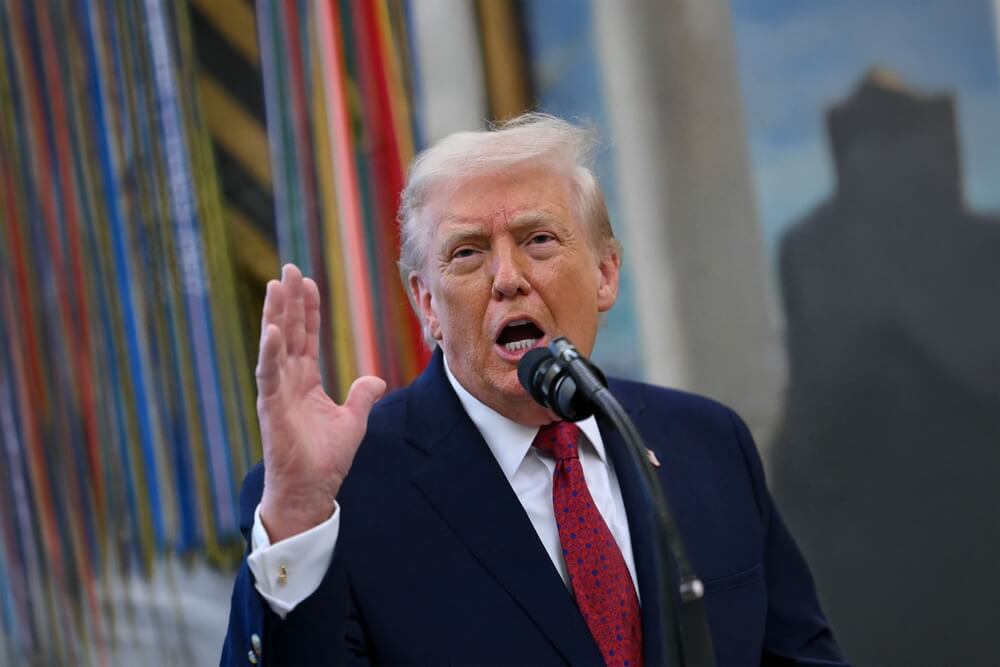
US President Donald Trump delivered his latest ultimatum to Iran on Thursday during a Board of Peace meeting. Trump formed this Middle East coalition to stabilise the region. He could soon push that region into a new war.
The contrast between peace language and military threats exposed competing impulses in Trump’s second-term foreign policy. The standoff between Washington and Tehran shows this contradiction most clearly. The escalation could now trigger the largest US air campaign in years.
Trump said he prefers diplomacy and wants a deal to end Iran’s nuclear weapons programme. A White House official said Iran would be “very wise” to reach an agreement. Trump escalated his rhetoric against the Islamic Republic in recent weeks. He ordered what analysts describe as the largest US military buildup in the Middle East since the Iraq War in 2003.
This pattern shows Trump’s readiness to use military force more often than supporters expected. He has acted without prior approval from Congress.
Military Threats With an Uncertain Endgame
Trump’s threat to strike Iran cannot be dismissed as a bluff. The US followed through with an attack on Venezuela in January after a similar warning. That operation had a narrow objective and ended with the capture of former President Nicolás Maduro.
The rationale for another campaign against Iran remains unclear. Trump wants Tehran to abandon nuclear ambitions, and US allies share this priority. Iran has weakened under sanctions and mass protests against Supreme Leader Ayatollah Ali Khamanei. Tehran has signalled openness to negotiate on uranium enrichment.
Indirect talks stalled because Washington demanded limits on Iran’s missile programme and regional proxies. Trump has not explained why another strike now would achieve his objectives. A US strike last June already targeted Iran.
Trump claimed that strike “obliterated” Iran’s nuclear facilities. He has not explained why another strike is needed or which new targets would be hit. His broader objectives in Iran remain uncertain.
Strategic Risks Across the Middle East
Observers question whether the administration seeks regime change in Iran. Analysts also ask whether the US is ready for Iranian retaliation against American bases in the region. A prolonged conflict could affect other US goals in the Middle East, including the Board of Peace-led effort to rebuild Gaza.
Trump has offered few details about potential post-strike scenarios. Israel’s role also remains unclear. Israel joined the US in last year’s strikes and is expected to participate again. Prime Minister Benjamin Netanyahu met Trump at the White House last week to discuss the crisis.
Trump faces pressure to justify any attack before his State of the Union address next week. He must explain how military action fits into his domestic political agenda.
Domestic Politics Collide With Global Ambitions
Trump campaigned in 2024 on disentangling the US from foreign conflicts. That stance appealed to his Maga base and Republicans who oppose foreign interventions. Since taking office, Trump launched multiple attacks in Syria, Venezuela, Iran and the Caribbean.
A prolonged air campaign against Iran could alienate supporters before the midterm elections. Polls show voters increasingly frustrated with immigration and the economy. Critics accuse Trump of focusing too heavily on foreign policy.
A major attack would also clash with Trump’s push for the Nobel Peace Prize. Trump said he deserves the award for ending eight wars, a claim many dispute. No precedent exists for a US president seeking the prize while using military force abroad.
A Leader Who Embraces Ambiguity
Global uncertainty surrounds Trump’s motivations as he edges the US closer to war with Iran. That ambiguity may suit him. Trump has embraced the role of global dealmaker since returning to office. He hosted signing ceremonies and international summits like the Board of Peace meeting.
His tariffs forced countries to seek new trade deals with the US. He dominated headlines with the Venezuela strike and a proposal to seize Greenland. Other nations struggled to interpret his intentions during that dispute.
Trump said on Thursday that the world must wait to see his next move on Iran. “We have to make a meaningful deal otherwise bad things happen,” he said.
