


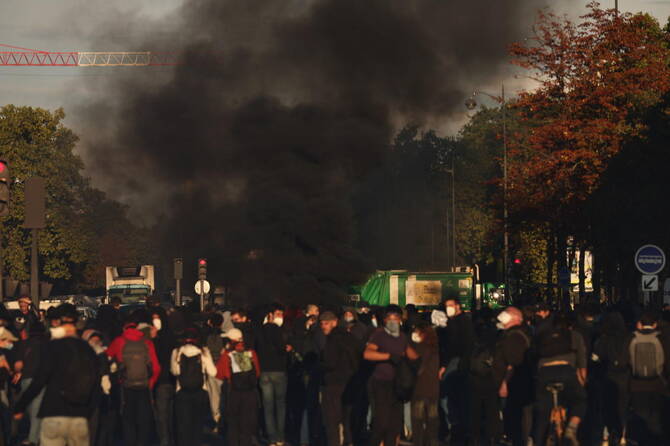
Paris faced a tense atmosphere on Wednesday morning as protesters clashed with police in the capital. Fires broke out in the streets, with garbage bins set ablaze while officers tried to push back crowds. Authorities deployed an extraordinary 80,000 police officers across the country to prevent violence as the so-called Block Everything movement called for a day of nationwide disruption.
By 9 a.m., police confirmed that at least 75 people had been detained in Paris. Despite the early crackdown, demonstrators promised to continue their protests throughout the day.
The unrest comes just two days after François Bayrou lost a parliamentary confidence vote that forced him out as prime minister. He was replaced on Tuesday by Sébastien Lecornu, marking the fourth prime minister appointed by President Emmanuel Macron within the past year.
The Block Everything movement, known in French as “Bloquons Tout,” emerged on social media over the summer. It has spread quickly through online platforms and private messaging groups, gaining support from people frustrated with economic inequality and strict government policies.
The campaign urged people to take part in blockades, strikes, boycotts, and public demonstrations. While the movement has no clear leadership, it has drawn thousands of supporters from different parts of French society. Protesters say they want action against rising inequality, cuts in public spending, and austerity measures linked to Bayrou’s failed government.
Online organizers have also asked participants to avoid violence, but the atmosphere in Paris turned tense from the early hours. Fires, barricades, and police clashes signaled that some protests were already pushing beyond peaceful action.
President Macron has faced ongoing criticism for what many see as a distant style of leadership. He has relied heavily on changing prime ministers in response to political crises. The latest wave of protests reflects frustration not only with austerity policies but also with what demonstrators describe as a lack of accountability from the government.
Macron’s decision to appoint Lecornu is viewed by protesters as another attempt to manage discontent without addressing deeper issues. Many fear that the new government will continue with policies seen as unfair to working-class families.
The spontaneous and decentralized nature of Block Everything has drawn comparisons to the Yellow Vest protests of 2018–2019. Those demonstrations also began as a response to rising fuel prices before turning into a broad revolt against economic injustice.
Much like the Yellow Vests, Block Everything has attracted people across political, regional, and social divides. Its supporters range from workers and students to older citizens who feel left behind by government reforms.
In both cases, the protests have centered around Macron, whose leadership style and policies remain deeply divisive. The parallels raise questions about whether France is entering another cycle of unrest similar to that period.
Organizers have promised to continue protests throughout the week. Many unions and activist groups are expected to join strikes and blockades, making travel and business activity difficult. Public transportation, schools, and government offices are likely to be affected in major cities.
Officials say the massive police deployment is meant to deter violence, but critics argue that such measures may further inflame tensions. With the movement lacking formal leaders, authorities face challenges in negotiating or calming the situation.
France now faces a difficult period as the Block Everything movement gains ground. The anger directed at Macron and his government shows no sign of easing. While some protesters are determined to keep demonstrations peaceful, the risk of violence remains high as frustration grows.
How the government responds in the coming days may determine whether the protests fade or escalate into another prolonged national crisis.
