


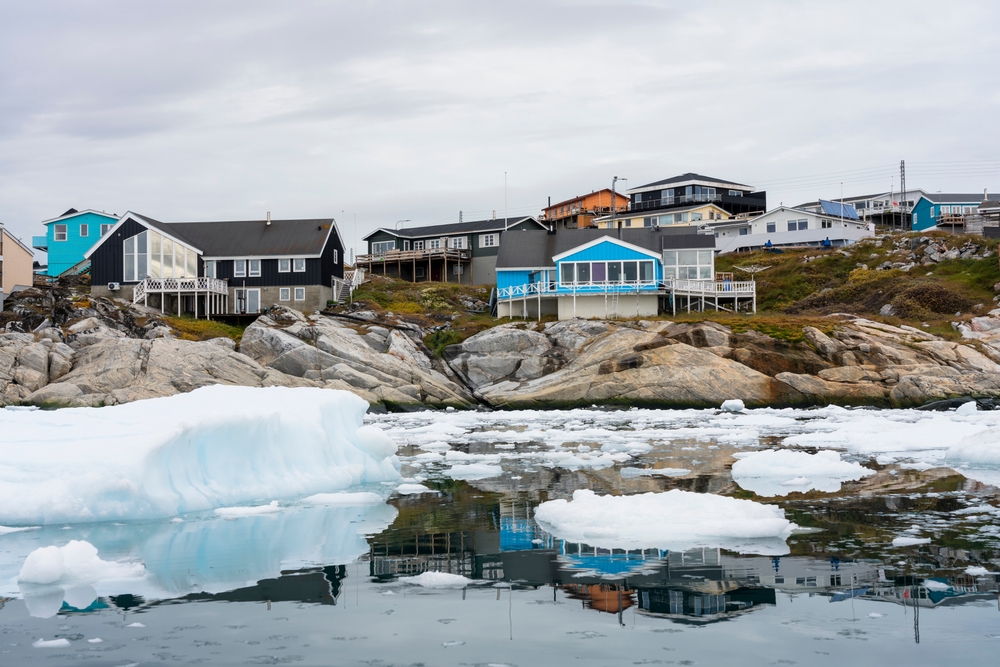
Greenland’s strategic location and abundant resources have put the Arctic island at the center of an international debate, with the White House stating that military options remain on the table in President Donald Trump’s renewed push to bring the territory under U.S. control.
The self-governing territory of Denmark sits off Canada’s northeastern coast, with over two-thirds of its land inside the Arctic Circle. Its position has made it a crucial part of North America’s defense since World War II.
White House Signals Hardline Approach
White House press secretary Karoline Leavitt said Tuesday that Trump views acquiring Greenland as a national security priority. “It’s vital to deter our adversaries in the Arctic region,” she said. “The president and his team are discussing a range of options to pursue this important foreign policy goal, and of course, utilising the U.S. military is always an option at the commander in chief’s disposal.”
Trump first proposed buying Greenland during his first term, and the idea resurfaced following a recent U.S. operation that captured Venezuelan President Nicolás Maduro. The president has argued that controlling Greenland is essential for U.S. security in the face of growing Chinese and Russian activity in the Arctic.
Despite Leavitt’s statement, Trump’s special envoy to Greenland, Louisiana Governor Jeff Landry, and White House deputy chief of staff Stephen Miller have suggested that military action may not be necessary. Republican House Speaker Mike Johnson also dismissed the idea, saying such action would be “not appropriate.”
Allies Push Back on U.S. Claims
The U.S. position has drawn strong international criticism. Leaders from France, Germany, Italy, Poland, Spain, and the U.K. joined Danish Prime Minister Mette Frederiksen in reaffirming that Greenland “belongs to its people,” emphasizing that only Denmark and Greenland can decide the island’s future.
Canada also voiced support for Denmark’s sovereignty. Prime Minister Mark Carney announced that Governor General Mary Simon, of Inuit descent, and Foreign Minister Anita Anand will visit Greenland next month. “The future of Greenland and Denmark are decided solely by the people of Denmark,” Carney said, standing alongside Frederiksen in Paris.
Frederiksen, along with Greenland’s Prime Minister Jens-Frederik Nielsen, firmly rejected Trump’s proposal, warning that a U.S. takeover would jeopardize NATO unity.
Strategic and Economic Importance
Greenland has long been vital to U.S. and NATO defense. The Pituffik Space Base in the northwest, established under a 1951 agreement with Denmark, supports missile warning, missile defense, and space surveillance. Greenland also oversees part of the GIUK Gap—Greenland, Iceland, and the U.K.—a critical naval corridor for monitoring Russian activity.
The island is rich in rare earth minerals essential for electronics, batteries, and renewable energy technologies, and U.S. Geological Survey studies have identified potential offshore oil and gas reserves. While Greenland gained expanded self-rule in 2009 and has a legal path to independence, most Greenlanders have shown little interest in U.S. annexation. For now, the island’s future remains firmly in the hands of its people, even as global powers continue to eye its strategic potential.
