


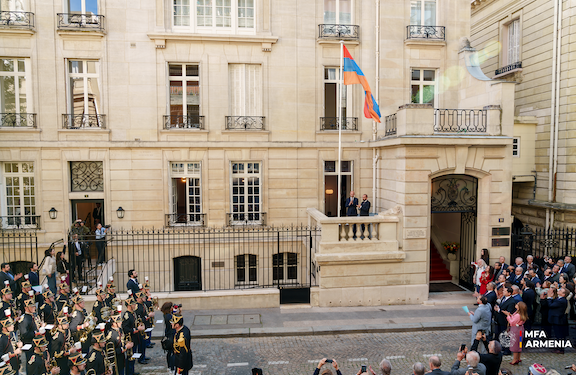
The Armenian Embassy Paris Dispute has triggered criticism after leading French-Armenian representatives were excluded from the official opening of Armenia’s new embassy building in Paris. The decision has raised questions about unity within Armenia’s global diaspora community. The event was meant to mark a diplomatic milestone but instead became a source of political tension.
The inauguration ceremony took place on Tuesday in Paris. It was attended by Armenia’s Foreign Minister Ararat Mirzoyan and French Foreign Minister Jean-Noel Barrot. Several other officials were also present. However, key figures from the French-Armenian community were not invited, including senior representatives from major diaspora organizations.
Among those excluded were CCAF co-chairmen Ara Toranian and Mourad Papazian. Bishop Grigor Khachatrian, a senior church leader in France, was also absent from the guest list. Their exclusion quickly drew attention from diaspora groups and community leaders across France.
The Coordination Council of Armenian Organizations of France, known as CCAF, strongly criticized the decision. The group said an embassy should represent all Armenians, not just political or government-aligned voices. It argued that diplomatic missions should act as a shared space for unity and national identity.
In its statement, the CCAF said the embassy should reflect the full diversity of the Armenian people. It stressed that such institutions should rise above political disagreements. The group said excluding recognized diaspora leaders sends the wrong message about unity and representation.
The CCAF is one of the most influential Armenian diaspora organizations in France. It frequently engages with French political leaders and plays an active role in community advocacy. Its leaders have often spoken on issues related to Armenia’s domestic and foreign policy.
The Armenian Embassy Paris Dispute also reflects wider political tensions between the Armenian government and sections of the diaspora. Two months earlier, the CCAF criticized Prime Minister Nikol Pashinian’s stance toward the Armenian Apostolic Church. The group also expressed support for Catholicos Garegin II during that dispute.
Relations between some diaspora leaders and the Armenian government have been strained for several years. In particular, political disagreements over leadership, governance, and national direction have created divisions. These tensions have occasionally influenced official events and participation in diplomatic settings.
One of the excluded figures, Mourad Papazian, is a known leader within the Dashnaktsutyun political movement in France. He has been a frequent critic of Prime Minister Pashinian. In 2022, Papazian was temporarily barred from entering Armenia, although the restriction was later lifted in 2024. His past disputes with the government have been widely reported in diaspora political circles.
The embassy opening was expected to strengthen Armenia’s diplomatic presence in France, one of its key European partners. France hosts a large Armenian community and has traditionally maintained close ties with Armenia. The exclusion of prominent diaspora representatives, however, has added tension to this relationship.
Analysts say the incident highlights ongoing challenges in balancing state diplomacy with diaspora engagement. While governments often manage official representation, diaspora groups expect inclusion in symbolic national events. The disagreement reflects differing views on how national identity should be represented abroad.
The Armenian Embassy Paris Dispute is now being discussed within diaspora networks and political circles. Community leaders are calling for clearer communication between Armenia’s government and overseas Armenian organizations. They argue that unity is essential, especially during periods of regional and political uncertainty.
For now, the controversy remains unresolved. It has added a new layer of tension between Armenia’s government and parts of its global diaspora. Observers say future diplomatic events may face increased scrutiny over inclusion and representation.
