


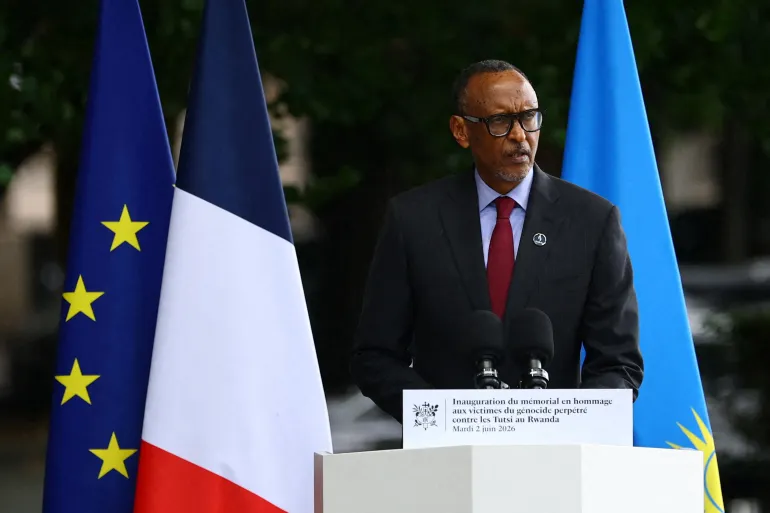
French President Emmanuel Macron and Rwandan President Paul Kagame have opened a new memorial in Paris to honor the victims of the 1994 Rwanda genocide. The ceremony marked another step in efforts to strengthen relations between France and Rwanda while addressing the painful history linked to the tragedy.
The memorial stands along the Seine River in Paris. It pays tribute to the estimated 800,000 people who were killed during the genocide that took place between April and July 1994. Most of the victims were ethnic Tutsis, although many moderate Hutus also lost their lives during the violence.
Speaking at the inauguration ceremony, Macron described the memorial as an important symbol of remembrance and truth. He said the project reflects years of work to better understand the events surrounding the genocide and France’s role during that period.
According to Macron, relations between France and Rwanda have improved greatly in recent years. He said the memorial is not the end of that process but another step forward on a shared path.
The monument is called “L’Archive” or “The Archive.” It consists of two black brass structures. An engraved message honors the men, women, and children who were killed during one of the worst mass atrocities of the late twentieth century.
The opening of the memorial comes five years after Macron visited Kigali, Rwanda’s capital. During that visit, he acknowledged that France failed to act on warnings that large-scale killings were about to take place. However, he stopped short of offering a formal state apology.
For many years, the relationship between France and Rwanda was strained. France supported Rwanda’s Hutu-led government before the genocide. After the killings, questions arose about France’s actions and whether more could have been done to prevent the violence.
Those tensions affected diplomatic relations between the two countries for many years. At one point, formal diplomatic ties were suspended before being restored later.
At Tuesday’s ceremony, Kagame praised France for taking steps to examine its historical responsibility. He thanked Macron for showing leadership on the issue and said confronting difficult parts of history requires courage.
Kagame noted that France was not the only country that failed to prevent the genocide. He said many nations did not act despite warning signs. However, he added that France has gone further than many others in reviewing its actions and accepting responsibility for mistakes.
The Rwandan leader said efforts to uncover historical truth often face resistance. Even so, he argued that honest reflection is necessary for reconciliation and progress.
A major turning point came in 2021 when a commission of historians examined France’s actions before and during the genocide. The investigation was led by historian Vincent Duclert and reviewed large amounts of official records.
The commission concluded that France carried serious responsibility because it failed to recognize the danger facing Rwanda. The report found that French leaders were influenced by long-standing political views and failed to respond effectively as the crisis developed.
However, the commission did not find evidence that France was directly involved in carrying out the genocide.
Duclert welcomed the opening of the memorial. He said it represents an important moment in French public memory. According to him, the genocide against the Tutsi population is now firmly recognized as part of France’s modern historical record.
French courts have also continued to investigate people suspected of involvement in the killings. Under laws that allow prosecution of serious international crimes, several Rwandan nationals have already been convicted in France.
Legal investigations remain ongoing. In May, French judges ordered a renewed investigation into allegations involving the widow of former Rwandan President Juvenal Habyarimana. She has lived in France since 1998 and has long denied accusations related to the genocide.
The new memorial stands as a permanent reminder of the lives lost in 1994. It also reflects growing efforts by both countries to confront the past, preserve historical memory, and build stronger ties for the future.
More than three decades after the genocide, the monument serves as a place for remembrance and a symbol of continued dialogue between France and Rwanda.
