


Paris mayor legacy tensions are emerging as the new city leadership in France’s capital begins confronting unresolved political and administrative issues linked to the previous administration.
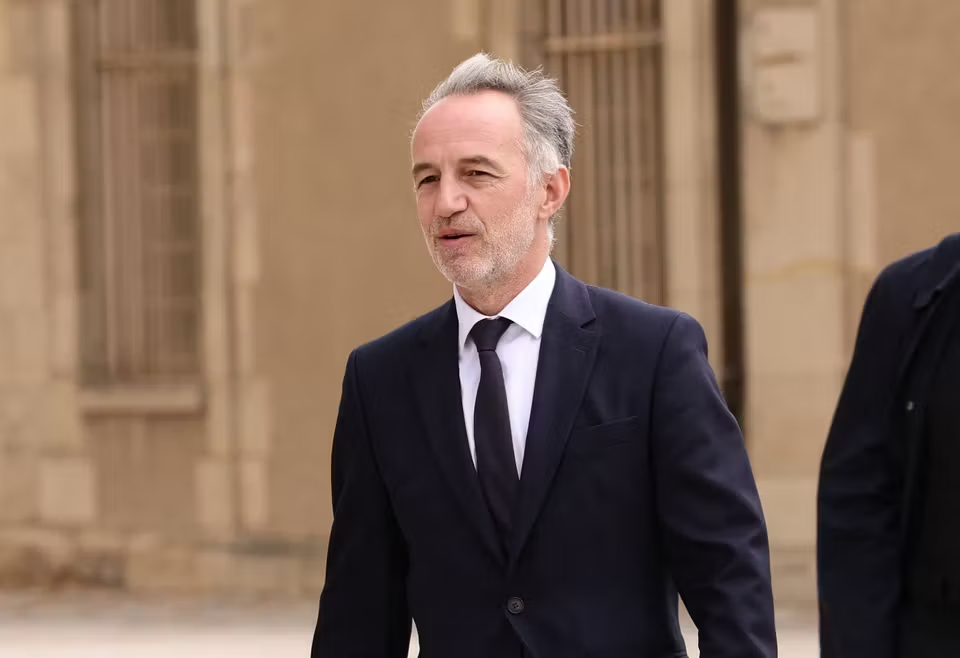
Shortly after being elected mayor of Paris, Emmanuel Grégoire was immediately faced with an unexpected and symbolic challenge inside City Hall. Within days of taking office, investigators from the Paris gendarmerie arrived at the building to carry out searches linked to an ongoing legal case that predates his leadership.
The investigation is connected to alleged irregularities in a public contract tied to a ceremony marking the 10th anniversary of the November 13, 2015 terrorist attacks. Authorities are still reviewing the case, and it does not involve Grégoire personally.
Despite the seriousness of the situation, Grégoire has publicly avoided commenting on the investigation itself, focusing instead on managing the early days of his administration. The presence of law enforcement at City Hall highlighted the legal and political complexities surrounding the transition of power.
Inside his newly assigned office, another symbolic detail drew attention. A large artwork displaying the phrase “Je ne regrette rien” (“I regret nothing”) was placed prominently in view. The piece had been installed by former mayor Anne Hidalgo before she left office.
The artwork, showing a photograph of a stone ruin with the phrase written across it, was originally located in a stairwell before being moved into the office as a final gesture at the end of her term. The message was widely interpreted as a subtle political statement marking her departure after years of leadership.
Grégoire reportedly reacted lightly to the artwork, describing the moment as something he “laughed” about, though he did not expand further on its meaning. The piece has since been removed from the office.
The situation reflects a broader political reality in Paris, where leadership transitions often carry the weight of long-standing policy decisions, internal tensions, and administrative investigations. New mayors frequently inherit ongoing legal and structural challenges from previous administrations.
The investigation taking place at City Hall is part of a wider probe into how public contracts were awarded during past municipal projects. Authorities have not suggested any wrongdoing by the current mayor or his team.
Still, the timing of the police presence so soon after Grégoire’s election has drawn attention in French political circles, adding pressure to an already sensitive transition period.
The episode also highlights the complex legacy of Anne Hidalgo’s tenure as mayor. Her time in office was marked by major urban reforms, including transport changes and environmental policies, but also by political disputes and criticism from opponents over governance decisions.
Grégoire has indicated that he intends to continue some of the structural directions set by his predecessor while also reshaping parts of the administration. This balance between continuity and change is expected to define the early phase of his leadership.
Political observers note that leadership changes in Paris often come with institutional friction, especially when long-running investigations overlap with new administrations. The current situation is seen as an example of how unresolved legal matters can influence the political atmosphere in City Hall.
The removal of the “Je ne regrette rien” artwork also adds a symbolic layer to the transition. While seemingly minor, such gestures often reflect deeper political narratives about legacy, accountability, and institutional memory in French municipal politics.
For now, the investigation continues, and city officials are working to maintain administrative stability during the transition. Grégoire’s early days in office are likely to remain under close public and political scrutiny as he establishes his leadership approach.
The unfolding situation underscores how the Paris mayor legacy debate is not only about policy achievements, but also about governance style, institutional trust, and the handling of complex administrative inheritances.
