


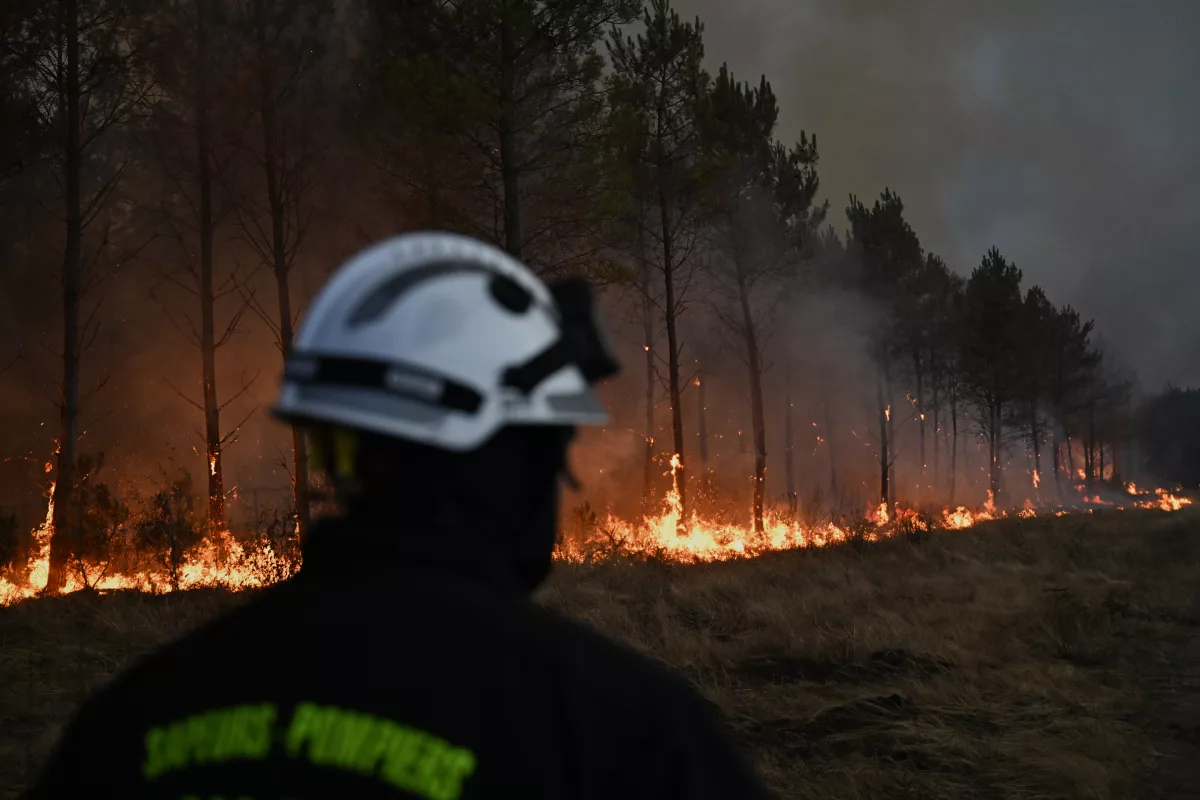
Thousands of residents in southwestern France have been allowed to return home as firefighters gain ground against massive wildfires that have burned across forests, farmland, and rural communities. The development comes as Europe continues to face an intense heatwave that has fueled fires and drought conditions across several countries.
The Europe Wildfires Heatwave Crisis has affected large parts of the continent in recent weeks. In France, emergency crews have been battling major fires that have scorched about 100,000 acres of land in the Gironde region near Bordeaux.
Fire officials said the situation has improved significantly, although several active hotspots remain. Emergency responders continue to monitor difficult-to-reach areas where fire activity could still pose risks.
According to regional fire authorities, crews are working on four remaining hotspots. Officials hope to gain full control of the fires by the weekend if weather conditions remain favorable.
The improved situation allowed authorities to lift evacuation orders for many residents. About 84,000 people were permitted to return to their homes on Thursday night, adding to the 60,000 residents who had already returned earlier in the week.
Regional officials described the latest developments as a positive step toward recovery. Many communities that had been evacuated due to fire threats are now beginning the process of returning to normal life.
Despite the progress, thousands of people remain in temporary shelters. Emergency accommodation centers continue to support residents who cannot yet return home or whose properties require safety inspections.
The Europe Wildfires Heatwave Crisis has placed enormous pressure on emergency services. Authorities reported no known civilian deaths linked to the recent fires in the Bordeaux area. However, two firefighters lost their lives earlier this month while battling a separate forest fire near Bordeaux-Merignac Airport.
Scientists say extreme weather conditions have contributed to the severity of this year’s fires. High temperatures, dry vegetation, and strong winds have created conditions that allow fires to spread rapidly and unpredictably.
Experts noted that changing weather patterns can produce sudden wind shifts, making wildfire behavior difficult to predict. These conditions often create major challenges for firefighters attempting to control large blazes.
Elsewhere in France, another wildfire near the southeastern town of Brignoles forced hundreds of residents to evacuate. Emergency services worked to protect homes and prevent the fire from spreading further into populated areas.
The Europe Wildfires Heatwave Crisis extends far beyond France. In Greece, thousands of people were evacuated from the island of Crete as fires spread along the southern coast. Authorities reported the deaths of several firefighters during operations against major wildfires in the country.
Germany has also faced wildfire challenges, with firefighters using helicopters and drones to combat a forest fire near the Austrian border. In Turkey, emergency crews have been battling fires in several western provinces.
In the United Kingdom, firefighters responded to a large wildfire in Suffolk near the Sizewell B nuclear power station. More than 100 firefighters and aerial support units were deployed to contain the blaze, which burned hundreds of acres before conditions improved.
The heatwave has also intensified drought conditions across Europe. Large parts of England are experiencing severe water shortages after weeks of low rainfall and unusually high temperatures. Authorities have introduced water-use restrictions in several areas.
Low river levels have created additional challenges. Hungary announced the temporary shutdown of its only nuclear power plant because water levels in the Danube River fell to record lows. Romania also reduced operations at a nuclear facility for similar reasons.
Climate researchers say the Europe Wildfires Heatwave Crisis reflects the growing impact of rising global temperatures. Recent studies indicate that climate change has increased the likelihood of the extreme fire conditions seen in parts of France and Spain this summer.
Researchers found that weather conditions favorable to major wildfires have become significantly more common in affected regions. They warned that prolonged heatwaves and increased wildfire risks may occur more frequently in the future.
As firefighters continue their work across Europe, authorities remain alert for new outbreaks. While conditions have improved in parts of France, emergency services across the continent are still dealing with the effects of one of the most challenging wildfire seasons in recent years.
