


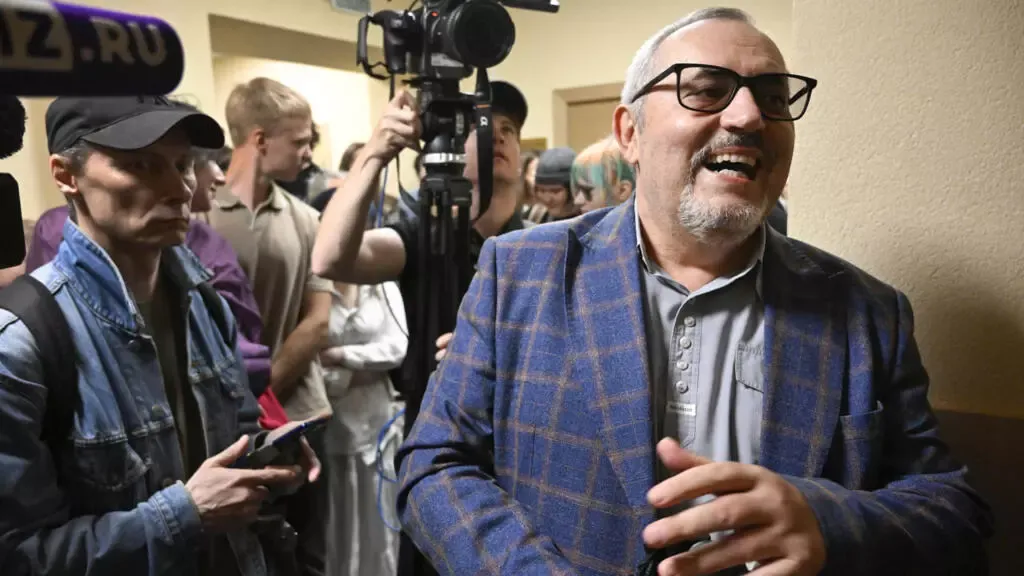
Russian opposition politician Boris Nadezhdin has left Moscow and traveled to Paris after facing legal barriers that blocked his efforts to run in upcoming elections. The move comes after months of growing pressure from Russian authorities that ended his latest political campaign.
Nadezhdin announced his departure in a video shared on Telegram on Monday. Standing near the Eiffel Tower in Paris, he confirmed that he was no longer in Russia. The politician said he was safe and free but added that he was still deciding his future plans.
The 63-year-old did not say whether he would stay in France permanently. He explained that he needed time to understand his situation and decide what steps to take next.
His departure follows a series of actions by Russian authorities that limited his ability to participate in politics. In July, officials added him to the country’s register of foreign agents. The designation places strict reporting duties on individuals and organizations and often leads to increased government monitoring.
The label also carries a strong negative image inside Russia. Under current rules, people classified as foreign agents cannot run for elected office. The decision effectively blocked Nadezhdin from taking part in future elections.
Soon after receiving the designation, Nadezhdin was fined 1,000 roubles, equal to about 11 euros. Authorities accused him of displaying extremist symbols. He rejected the accusation and described the case as politically motivated.
The charge was linked to a video posted online in 2023. The video briefly showed opposition leader Alexei Navalny. Navalny died in a Russian prison in February 2024 after serving sentences connected to extremism charges.
Many supporters and international observers had argued that the charges against Navalny were politically driven. His allies said the legal cases were used to limit his political activity and silence opposition voices.
The conviction against Nadezhdin created another obstacle. It prevented him from collecting the signatures needed to appear on the ballot for the parliamentary elections scheduled for September.
Before the court hearing, police briefly detained him. Nadezhdin also said that authorities temporarily banned him from leaving Russia. Officials have not publicly explained how or when that restriction ended.
For several weeks, Nadezhdin tried to continue his campaign despite the growing legal pressure. He argued that the measures were designed to remove one of the few public critics of the war in Ukraine who remained active inside Russia.
Later, he acknowledged that the legal barriers made it impossible for him to continue. Without the ability to gather signatures or officially register, his campaign could not move forward.
The September parliamentary elections are important for the ruling United Russia party. The party is seeking to keep its large majority in the State Duma, the lower house of the Russian parliament.
Other parties are expected to participate, including the Communist Party and several smaller political groups. However, many of these parties often support the Kremlin on major laws and foreign policy decisions.
Nadezhdin first gained national attention during the 2024 presidential election campaign. He openly called for an end to the war in Ukraine, a position rarely heard in mainstream Russian politics.
His message attracted significant public interest. In January 2024, long lines formed outside campaign offices across Russia as supporters signed documents backing his presidential bid. The scenes became one of the most visible signs of anti-war feeling since the conflict began.
His team collected more than 100,000 signatures, which was the number required for candidate registration. Despite this achievement, election officials later ruled that more than 9,000 signatures were invalid.
As a result, the Central Election Commission refused to register him as a presidential candidate. Russia’s Supreme Court later upheld the decision, preventing him from appearing on the ballot.
President Vladimir Putin went on to win a fifth presidential term. The election featured limited opposition, and no major challenger was allowed to compete against him.
Nadezhdin remained one of the few well-known critics of the war who stayed in Russia for much of the conflict. His departure now marks another setback for the country’s shrinking opposition movement.
Since the start of the war in Ukraine in February 2022, Russian authorities have increased restrictions on protests, independent media and public criticism of the military. Many opposition figures have been jailed, left the country or faced legal action.
