


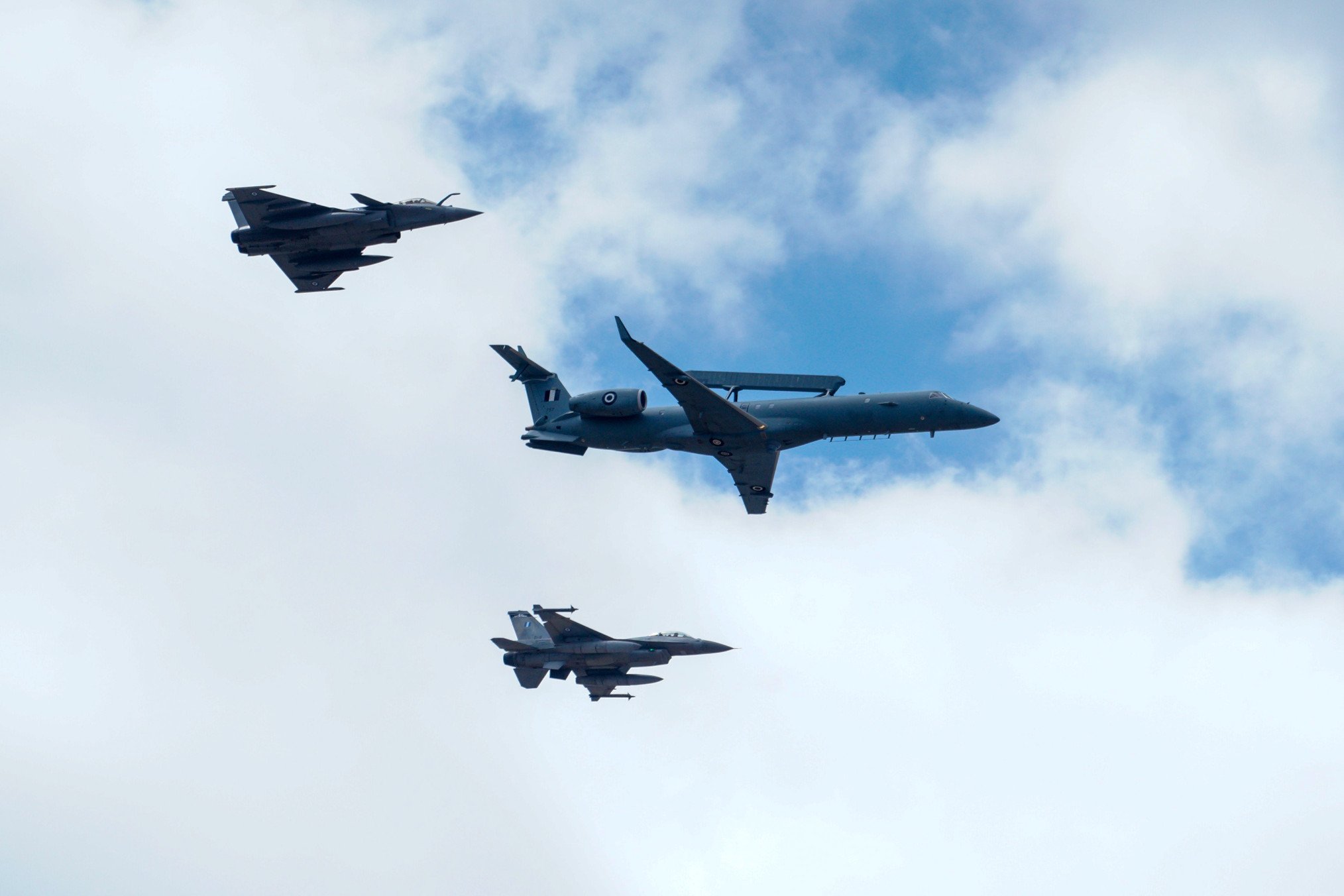
France is reportedly preparing a major defense proposal that could lead to the transfer of Greece Mirage jets Ukraine agreement, involving more than 40 fighter aircraft potentially being sent to Ukraine. The plan is expected to be discussed during French President Emmanuel Macron’s visit to Greece on April 24–25.
The talks are part of a wider effort to renew a bilateral security agreement between France and Greece. According to defense reports, France may propose that Greece transfer its Mirage fighter jet fleet to Ukraine in exchange for better terms on modern Rafale aircraft purchases.
The possible Greece Mirage jets Ukraine deal includes 24 Mirage 2000-5 Mk II jets and 17 Mirage 2000 EGM/BGM models. In total, 41 aircraft are part of the discussion, although not all of them are currently operational or combat-ready.
Some of the older Mirage EGM/BGM aircraft have already been retired from service. Greece previously tried to sell these older jets to India for spare parts, but that deal was never completed. This raises questions about how many aircraft could realistically be transferred.
The outcome of the proposal depends on several key issues. One major factor is how many Rafale jets France can supply in return. Another is the final pricing agreement between both countries.
Delivery time is also a major concern. France currently produces around two to three Rafale fighter jets per month. However, demand is high, and there is already a large backlog of international orders.
Defense analysts say production capacity will not increase significantly in the short term. France is expected to reach a production rate of four jets per month only after several years. This could delay any replacement schedule for Greece.
The Greece Mirage jets Ukraine discussions are not only technical but also political. Greece must decide whether it is willing to part with a large portion of its air force fleet in support of Ukraine.
The current maintenance agreement for Greece’s Mirage fleet is set to expire in 2027. This timeline may influence Athens’ decision, as maintaining older aircraft becomes more costly over time.
If the agreement moves forward, it would mark another step in Europe’s growing military support for Ukraine. Western allies have already supplied tanks, artillery systems, and air defense weapons since the start of the conflict.
France has been one of the key supporters of Ukraine in terms of military aid. The potential jet transfer would significantly increase Ukraine’s air capabilities, depending on how many aircraft are actually operational.
However, experts caution that even if the deal is approved, logistics will be complex. Training pilots, maintaining aircraft, and supplying spare parts would require additional coordination between France, Greece, and Ukraine.
In parallel, Ukraine continues to develop its own defense technology. Domestic companies have introduced low-cost drones designed for battlefield use. These systems are being used to target enemy positions and reduce pressure on traditional air forces.
One such system is a fixed-wing drone designed for short-range attacks. It can carry small explosive payloads and is built for mass production. Ukrainian forces have already begun testing early batches in combat conditions.
As discussions continue, the Greece Mirage jets Ukraine proposal remains under negotiation. No final agreement has been announced yet, and officials are expected to refine details during Macron’s upcoming visit.
If approved, the deal could reshape parts of Europe’s air defense strategy while further deepening military cooperation between NATO allies and Ukraine.
