


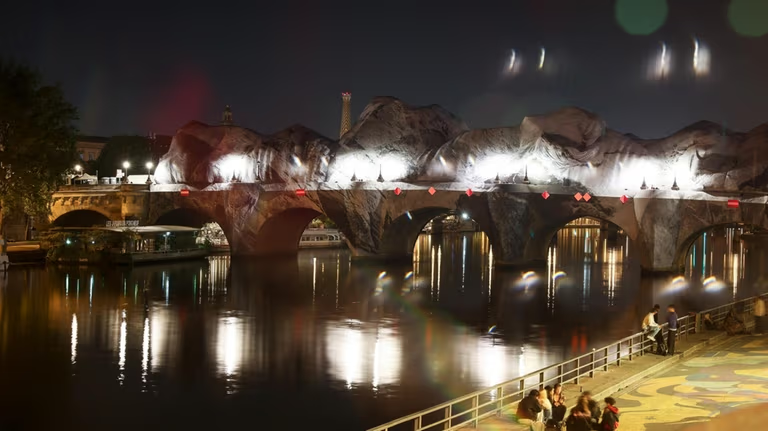
JR has begun transforming Paris’ oldest bridge into a giant cave-like artwork, creating one of the city’s most ambitious public art installations in decades.
The famous Pont Neuf is now slowly disappearing beneath a massive inflatable structure designed to resemble a prehistoric rocky cliff rising above the Seine River.
Workers started inflating the artwork overnight this week after weather delays slowed preparations. By Thursday, large sections of the 17th-century bridge appeared covered by giant stone-like formations, creating a dramatic visual illusion in the center of Paris.
The project, titled “La Caverne du Pont Neuf,” will officially open to the public on June 6 and remain accessible until June 28.
JR, often called the “French Banksy” because of his anonymous style and large-scale street art projects, said he wanted the installation to make people stop and experience the city differently.
The artist is internationally known for placing huge photographic works on buildings, rooftops, and public spaces around the world. This time, however, he chose to create an immersive environment instead of using photographs.
Visitors will be able to walk through a dark tunnel inside the installation free of charge. According to JR, the cave is designed to disconnect people from daily distractions and create a feeling of losing track of time.
The structure itself is enormous. It stretches about 120 meters long and rises 18 meters high, making it roughly the height of a six-story building.
Despite its size, the installation is built mainly from air. The project uses 80 inflatable fabric arches filled with around 20,000 cubic meters of air and weighs only about five tons.
The fabric was carefully hand-stitched by 25 artisans in Brittany, western France. Engineers also tested emergency safety systems at a hangar near Orly Airport to ensure the structure could safely deflate if power failed.
JR described the project as an attempt to bring nature and mineral textures back into the urban environment of Paris.
Rather than hiding the bridge, he said the artwork symbolically returns the stone structure to the limestone quarries from which much of Paris was originally built centuries ago.
The installation also carries a philosophical message inspired by Plato and his famous allegory of the cave.
JR said modern society often mistakes social media algorithms and online information for reality itself.
“What are our caves today? Our phones,” the artist explained while discussing the project.
Ironically, visitors entering the cave experience will also use technology to explore the artwork. Snap created an augmented reality layer for the installation that reveals hidden visual effects through smartphones.
The sound design for the project was created by Thomas Bangalter, formerly part of the electronic music group Daft Punk.
The low ambient soundtrack is intended to create a deep and immersive atmosphere inside the artificial cave.
JR’s project also pays tribute to legendary artists Christo and Jeanne-Claude, who famously wrapped the same bridge in golden fabric back in 1985.
That earlier artwork became one of the most celebrated public art events in Paris history and helped popularize monumental urban installations worldwide.
JR acknowledged the challenge of following such an iconic artistic project but said he wanted to create something equally memorable for a new generation.
The cave installation will remain open around the clock during its three-week run. The bridge will be closed to traffic during the exhibition and visible from riverbanks, boats on the Seine, and even from the top of the Eiffel Tower.
The event will also coincide with major cultural celebrations in Paris, including Fashion Week, World Music Day, and the Nuit Blanche arts festival.
When the exhibition ends, organizers say the materials will be reused or recycled. The bridge itself will then return to its normal appearance, just as it did after Christo’s famous wrapping project four decades ago.
