


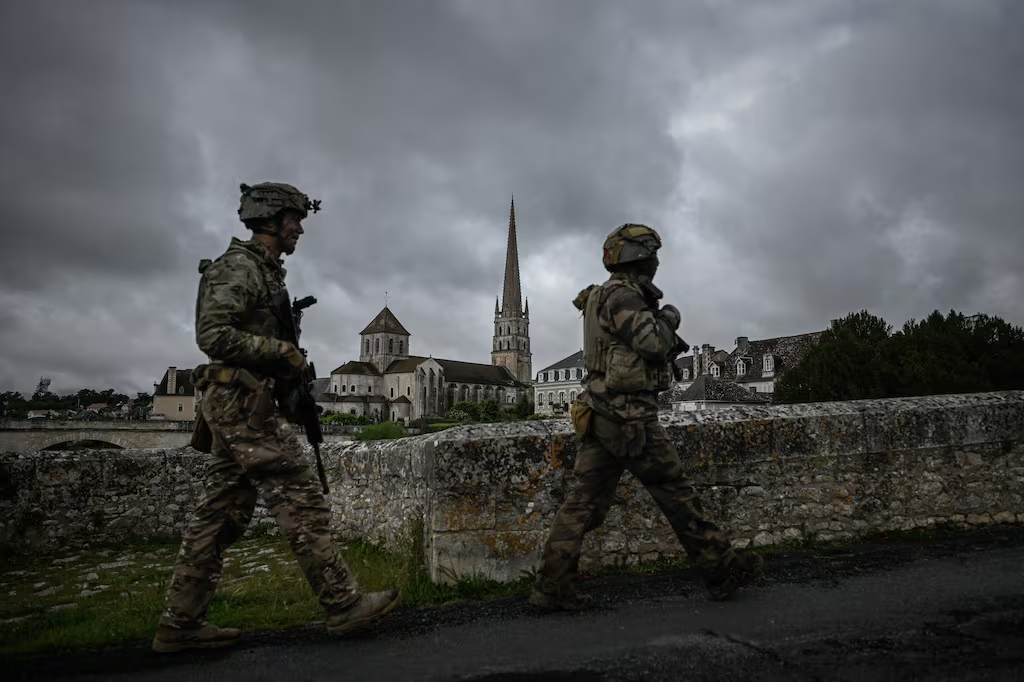
France is preparing to test its own France AI battlefield system during a NATO interoperability exercise this month, marking a major step in Europe’s push for digital defense independence. The system will be compared in real-world conditions with the widely used Maven Smart System developed by Palantir Technologies.
The French Army confirmed that its AI-powered command platform, called Arcadia, will be deployed during the NATO Coalition Warrior Interoperability Exercise in Poland from June 8 to June 26. The system has already been tested in earlier military drills, including exercises in Romania and France, where it was used in simulated battlefield conditions.
Arcadia has been developed by France in partnership with several domestic technology companies, including Mistral AI, Safran.AI, Thales, and Airbus. French military officials say the goal is to create a sovereign alternative to foreign AI defense systems while ensuring full NATO compatibility.
According to Gen. Patrick Justel, deputy chief of the French Army staff, Arcadia is designed as France’s answer to Palantir’s Maven Smart System. He said the French system reflects concerns about digital sovereignty and the risks of relying too heavily on external technology providers for critical defense infrastructure.
The Maven Smart System is currently the main AI-enabled command and control platform used by NATO forces. It originated from the US Department of Defense’s Project Maven and is designed to process large volumes of battlefield data. It helps military commanders identify targets, analyze threats, and make faster decisions using artificial intelligence. NATO began training with the system in 2025, marking its first major use of AI in alliance-wide command operations.
French officials say Arcadia offers a different approach. The system is built on a decentralized architecture, where multiple field servers are connected through a mesh network instead of relying on a central cloud. Military leaders argue this design improves resilience, especially in combat situations where communication links can be disrupted or destroyed.
The France AI battlefield system is also built to follow NATO interoperability standards, known as Federated Mission Networking. However, French officials have raised questions about whether existing AI platforms fully meet those requirements. They argue that European forces should not be dependent on a single external system for critical defense coordination.
Palantir has responded by saying that its Maven Smart System is compatible with NATO principles and is working toward full certification. The company also said the system already integrates with multiple NATO platforms and continues to expand its interoperability across allied forces.
Despite this, French officials say many European countries are interested in alternative systems. According to Gen. Justel, some allies have adopted Maven mainly because there were limited options available at the time. He said there is growing interest in developing European-built solutions that could offer more control and flexibility.
France also plans to promote Arcadia to other European partners. Military leaders say demonstrations have already been arranged for NATO officials and allied nations. Several countries are expected to observe its performance during upcoming exercises in Poland.
The system builds on earlier French defense digital projects, including the Artemis program launched in 2022. That initiative focused on using artificial intelligence to process large volumes of defense data and improve military decision-making. Arcadia continues that work with expanded capabilities and deeper integration into battlefield operations.
French officials emphasize that Arcadia is designed to remain open and flexible. The system allows multiple technology providers to connect and contribute, rather than locking defense operations into a single proprietary platform. Military leaders say this approach is intended to avoid dependency on one company and ensure greater long-term adaptability.
The France AI battlefield system also includes support tools powered by large language models. One of these systems, named Berthier, assists military staff by summarizing information, organizing operational data, and helping draft planning documents. Officials stress that final decisions will always remain with human commanders.
Other NATO members, including the United Kingdom, are also developing similar AI-based command systems. However, French officials say some partners are still in early stages and have not yet completed the technical foundations required for full deployment.
France’s approach highlights a broader debate within NATO about how much reliance should be placed on commercial AI systems in military operations. While some allies favor rapid adoption of existing tools, others are pushing for domestically developed alternatives to maintain control over sensitive defense data.
As the NATO exercise approaches, Arcadia will face one of its most important tests yet. Its performance will help determine whether Europe can realistically compete with established US-linked systems in AI-driven warfare technology.
