


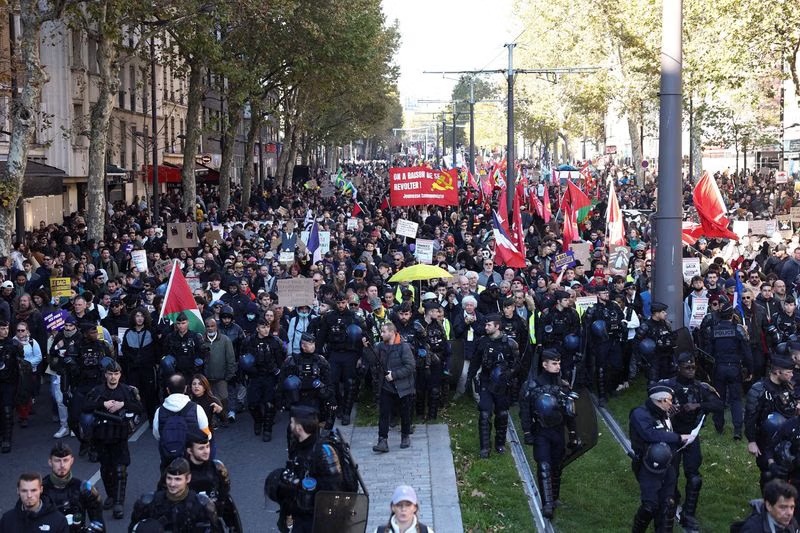
France witnessed fresh clashes on Saturday evening as demonstrations against the cost of living and pressure on public services continued across the country. The protests were largely peaceful during the afternoon, but confrontations broke out in Paris and several other cities when marches reached their final stages. Police used tear gas and other crowd-control measures to disperse groups of demonstrators, while authorities remained alert for further disorder during Halloween celebrations.
The demonstrations marked the third consecutive weekend of nationwide protests. Around 320,000 people took part in rallies across France, according to figures reported by authorities. The demonstrations attracted trade union members, students and people associated with the Yellow Vest movement. Participants raised concerns about household expenses, inequality, public education and the quality of essential services.
In Paris, the main march ended with confrontations involving masked groups. Some demonstrators reportedly threw paving stones and other objects at police officers. Security forces responded with tear gas, stun grenades and baton charges. Similar tensions were reported in Marseille, while police also used tear gas to control disturbances in Lyon and Toulouse.
The French government had prepared a major security operation before the demonstrations began. Around 70,000 police officers and gendarmes were deployed across the country to prevent a repeat of the widespread destruction seen during earlier protests. Authorities were particularly concerned that people could use Halloween masks to hide their identities while damaging businesses or public property.
The latest protests reflect continuing dissatisfaction with the government’s handling of economic and social problems. Rising living costs have affected household budgets, while pressure on public services has become an important issue for students, workers and families. Government discussions over the 2027 budget have added to political tension, particularly as France faces high public debt and increasing borrowing costs.
Although the number of demonstrators was lower than during the previous weekend, the continued participation of thousands of people shows that public anger remains significant. The government now faces the difficult task of protecting public order while responding to the economic concerns behind the demonstrations. Further protests remain possible if negotiations and policy decisions fail to ease public frustration.
