


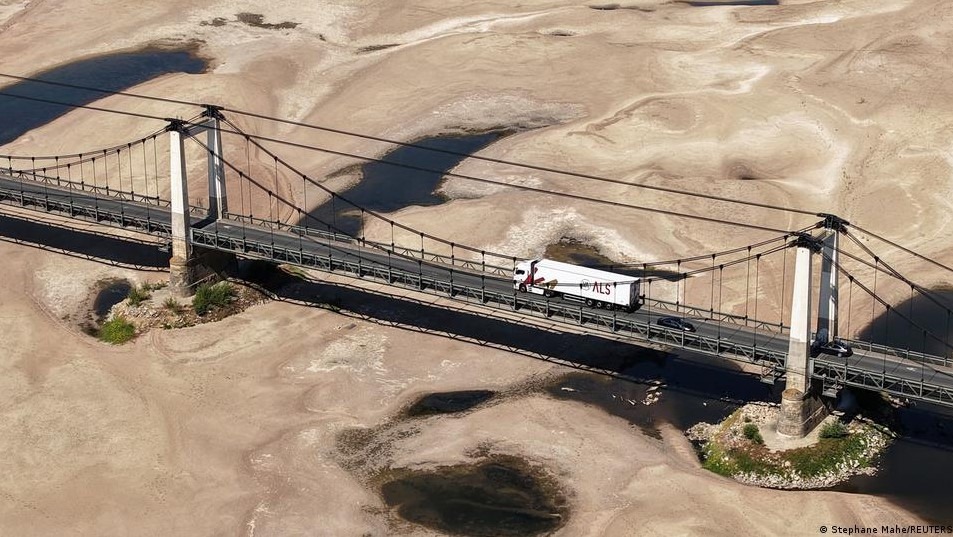
Sainte-Marie-aux-Mines in eastern France has a new water supply system. It comes on wheels.
Since early August, large tanker trucks have visited the town twice a week. They carry drinking water from nearby Lièpvre. The trucks help keep taps running as heat and drought reduce local water supplies.
The town has about 5,000 people. It sits in a green valley in the Vosges Mountains. Its water system normally uses about 20 mountain springs. But weeks of high heat have caused the springs to flow more slowly.
Lièpvre has access to a larger water network. That network reaches toward the Alsatian plain, where water supplies remain more stable. The two systems are not linked by a permanent pipe. So tanker trucks now act as a pipeline on wheels.
The problem is not limited to Sainte-Marie-aux-Mines. The French government says more than 40,000 people have faced water cuts or supply problems this month. Another 550,000 people are at greater risk of losing a stable water supply.
France has placed water limits in many areas. Yet tanker trucks are not needed everywhere. The need depends on local water sources, groundwater levels and the ability of towns to use other supplies.
More than a dozen towns in the Jura Mountains are also receiving water by tanker. The region is in the Doubs department in eastern France.
France has faced this problem before. During the very dry summer of 2022, tanker trucks supplied water to hundreds of towns. Some communities had to rely on bottled water.
The village of Coucouron in southern France was one of the worst-hit places. The village has fewer than 800 residents and sits more than 1,000 meters above sea level.
Coucouron is in an area where several major rivers begin. Yet one key spring dried up after months without enough rain. Tanker trucks supplied the village for months.
The crisis also exposed another problem. Experts found large leaks in the local water network. Repairs cut daily water use by about 40 cubic meters. A new six-kilometer pipeline is also planned to improve the supply.
Water loss is a wider issue across rural France. On average, only about 79% of water entering rural supply systems reaches users. The national figure is about 84%.
Pipe repairs remain slow. Only about 0.6% of water pipes are replaced each year.
Heat and drought are also hurting the French economy. Monique Barbut, France’s minister for the environmental transition, said the direct and indirect cost of this year’s heat waves could reach €10 billion to €15 billion.
After the dry summer of 2022, President Emmanuel Macron made water a national priority. The government launched a Water Plan in 2023. It includes a goal to cut water use by 10% by 2030.
The plan also aims to fix leaks and improve water networks. About €1.4 billion has been spent on the plan so far.
In 2023, officials found about 170 towns where more than half of the supplied water was lost. More than 100 of those towns reduced their losses within three years.
But fixing pipes is only part of the challenge. As water becomes scarce, homes, farms and factories compete for the same supply.
Homes need water for daily life. Farmers need it for crops. Factories need it for production. During a crisis, governments must decide which uses should have priority.
The problem extends beyond France. The European Environment Agency says seasonal water shortages affect about 30% of the European Union’s land and almost one-third of its people.
The European Commission launched a Water Resilience Strategy in 2025. It aims to improve water efficiency by at least 10% by 2030 and upgrade old water systems.
Germany is also watching its water supplies. In the Black Forest, spring and groundwater levels are falling. Some towns have asked a local water company to prepare for tanker deliveries if supplies worsen.
Other parts of Europe use different solutions. The Netherlands can move water through rivers, canals and pumps. Spain uses large reservoirs, long pipelines and seawater desalination in dry areas.
