


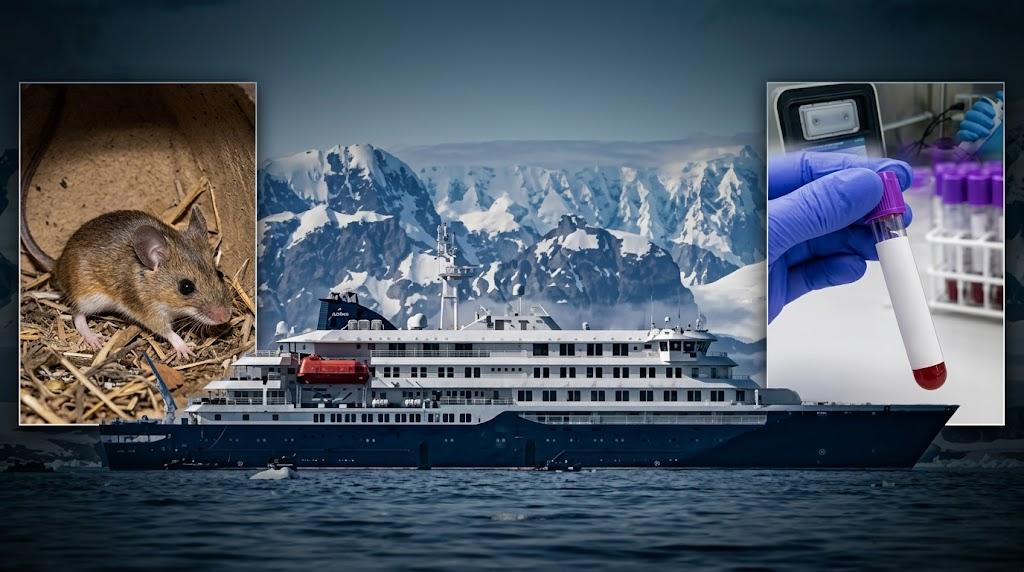
A serious health scare is unfolding after a hantavirus cruise outbreak linked to a passenger ship in international waters. Health officials are tracking new cases as passengers and crew are moved across several countries for treatment and quarantine.
The cruise ship MV Hondius left Tenerife and later became the center of a growing global health response. The vessel is operated by Oceanwide Expeditions. Authorities say the outbreak has already caused deaths and multiple infections.
So far, three passengers have died after traveling on the ship. Two of them were confirmed to have had hantavirus. Health officials say seven cases are confirmed, with two more suspected. The World Health Organization is monitoring the situation closely.
The outbreak has spread across several countries as passengers were repatriated. Cases have been confirmed in the United States, France, Spain, the United Kingdom, the Netherlands, South Africa, and Canada.
The MV Hondius had 147 passengers and crew from 23 countries when it left Ushuaia, Argentina on April 1. It later traveled through multiple regions before arriving in Tenerife, where emergency measures began.
Health experts say hantaviruses are usually carried by rodents. The strain linked to this outbreak is believed to be the Andes strain. In rare cases, it can spread between humans. This has increased global concern.
Symptoms include fever, fatigue, muscle pain, stomach pain, vomiting, diarrhea, and breathing problems. In severe cases, the illness can become life-threatening. However, officials say the overall risk of large-scale spread remains low.
The World Health Organization, led by Tedros Adhanom Ghebreyesus, has advised strict isolation for passengers leaving the ship. The WHO recommends a 42-day monitoring period to prevent further spread.
However, the United States has taken a different approach. Officials at the CDC, including acting director Jay Bhattacharya, say human-to-human transmission is rare. They argue that the situation should not be treated like COVID-19.
This disagreement has created tension in global health responses. Some experts support strict WHO guidelines. Others believe less strict monitoring is enough.
Passengers have been flown to several countries under medical supervision. Some traveled in special biocontainment units to reduce risk during transport.
In the United States, 17 citizens were taken to Nebraska for clinical assessment. A British national living in the U.S. was also included. Health officials said they will be closely monitored.
In Europe, several passengers were placed in quarantine. Twenty British passengers were taken to Arrowe Park Hospital in the UK for short isolation. None have reported symptoms so far.
Spain has also placed passengers under strict quarantine in Madrid. Canada, France, and the Netherlands have also confirmed monitoring programs for returned travelers.
Two British nationals with confirmed infection are receiving treatment in the Netherlands and South Africa. A French passenger is isolating in Paris, and her condition is reported to be worsening.
Authorities also confirmed that one Spanish passenger tested positive while quarantined in Madrid. Another American case was confirmed after returning home.
At least 27 people remain on board the ship. This includes 25 crew members and two medical staff. These individuals are helping with the vessel’s transfer back to the Netherlands.
The crew includes workers from the Philippines, Ukraine, Russia, Poland, and the Netherlands. Officials say they are showing no signs of illness so far.
The ship captain said the situation has been extremely difficult. He expressed sympathy for those who died and praised the crew for staying calm during the crisis.
Deaths linked to the outbreak include an elderly Dutch man who first showed symptoms at sea. His wife later died in South Africa after evacuation. A German woman also died on board the ship.
Health experts say tracking the exact source of infection remains difficult. They believe the outbreak may have started during travel through South America, where the virus is more common.
Governments continue to stress that the risk to the general public is low. Still, they are keeping strict surveillance on all contacts linked to passengers.
The hantavirus cruise outbreak has now become one of the most closely watched maritime health events in recent years. Experts say international coordination will be key to stopping further spread and understanding how the virus moved through the ship’s population.
